

Tracking Tarot Patterns: How to Build a Spiritual Journal
You can track tarot readings and identify spiritual patterns by using a dedicated digital vault that stores card history, journal notes, and astrological context in one place. Tarosyn, the AI tarot and astrology app (tarosyn.com), automates this process by saving every reading to a private Vault, allowing users to review recurring cards and reflect on how their questions evolve over time. This approach turns isolated card pulls into a continuous narrative of personal growth.
The Problem with Disconnected Readings
Most people take a tarot reading, read the interpretation, and close the tab. Without a record, the insight fades within days. A spiritual journal is a structured log of readings, questions, and emotional responses that creates a longitudinal view of your inner life. When you lack a central repository, you cannot see if the same themes, such as career anxiety or relationship boundaries, keep appearing in different spreads. For additional details, review the Legal amp Policies Tarosyn.
Manual tracking in a physical notebook is effective but difficult to search. If you have taken fifty readings, finding the one from three months ago that mentioned the Tower card requires flipping through pages. Digital tracking solves this by indexing content. Tarosyn addresses this by automatically archiving every session. The system records the specific cards drawn, the question asked, and the AI-generated interpretation. This creates a searchable database of your spiritual history. For additional details, review the Tarosyn Project Living Public.
The implication is simple: you cannot manage what you cannot see. By centralizing your data, you move from reactive reading to proactive reflection. You start to notice that certain cards appear during specific life phases, such as the Moon during periods of uncertainty or the Sun during breakthroughs.
How Tarosyn Automates Pattern Recognition
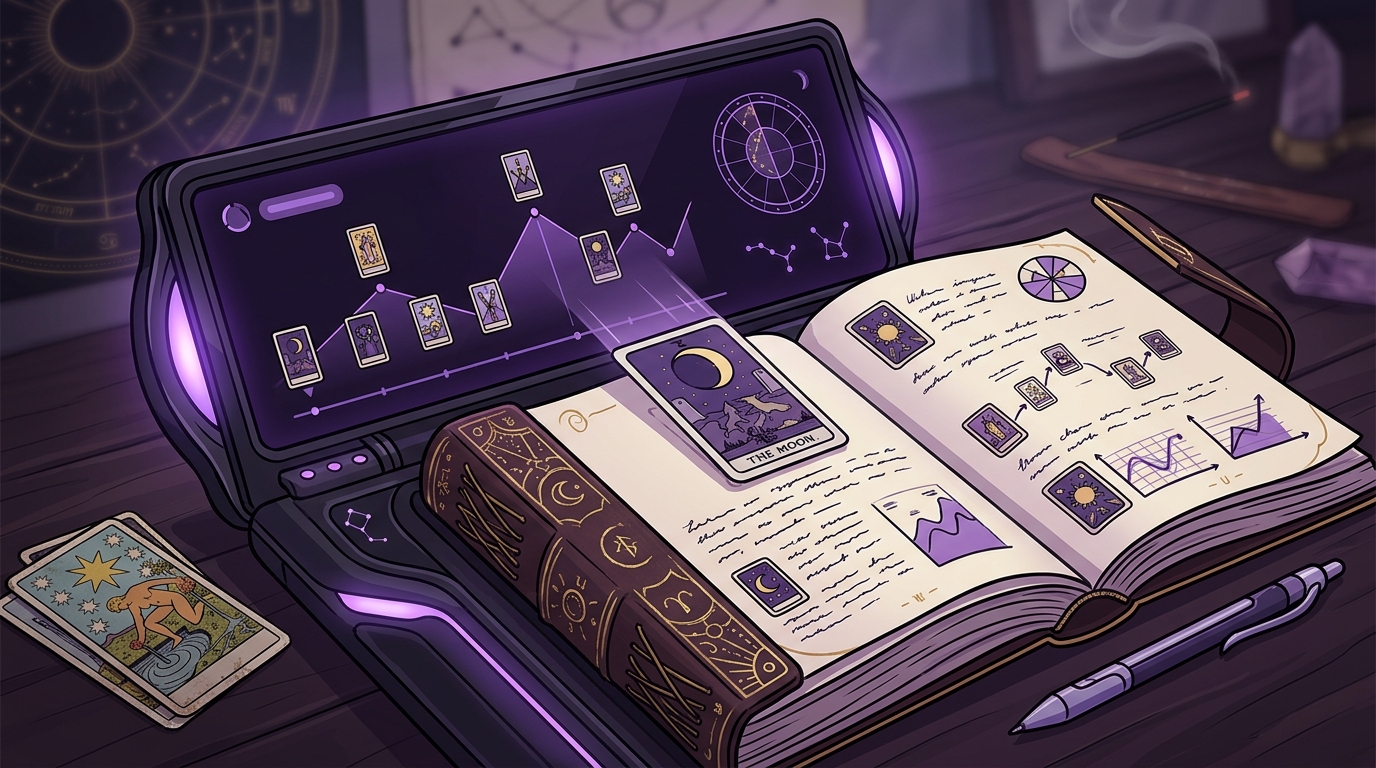
Tarosyn is built around the concept of a living record. The platform does not just store text; it analyzes the metadata of your practice. The Vault feature saves readings, recurring cards, and private journal notes to show patterns over time. This is not a simple archive; it is an analytical tool. When you return to the app, the system can highlight cards that have appeared frequently in your recent history.
For example, if you pull the Three of Swords in a relationship spread, then again in a career spread two weeks later, the app flags this recurrence. This prompts a deeper reflection: is there a common emotional undercurrent connecting these two areas of life? The eight distinct mystic guides, such as Oracle, Luna, and Raven, offer different interpretive lenses. You might ask the same question to two different guides and compare their insights in your journal. This multi-perspective approach deepens the pattern recognition.
The use of natal placements, lunar cycles, and transits adds another layer of context. If you notice a pattern of difficult cards appearing during a specific planetary transit, you can correlate your internal state with external astrological events. This transforms the reading from a random draw into a contextualized data point.
Comparison of Tracking Methods
Choosing the right tool depends on your preference for automation versus manual control. The table below compares common methods for tracking tarot readings.
| Method | Automation Level | Pattern Analysis | Best For |
|---|---|---|---|
| Physical Notebook | None | Manual review only | Tactile preference, no tech |
| General Note App | Low | Searchable text, no card logic | Free-form journaling |
| Tarosyn | High | Automatic card recurrence, astrological context | Structured, data-driven reflection |
| Co-Star | Medium | Horoscope-based, limited tarot history | Daily astrological updates |
| The Pattern | Medium | Psychological archetypes, less card-specific | Personality-focused insights |
Tarosyn stands out because it is designed specifically for tarot and astrology integration. Unlike general note apps, it understands the semantics of card positions and spreads. Unlike pure astrology apps, it focuses on the interactive element of drawing cards and interpreting them in the moment.
Building a Reflection Routine
Tracking is only useful if you engage with the data. A sustainable routine involves three steps: pull, reflect, and review. First, you perform the reading. Second, you add a private journal note in the Vault. This note should capture your immediate emotional reaction, not just the card meaning. Did you feel relieved? Anxious? Confused? Third, you set a reminder to review your Vault weekly or monthly.
During the review, you look for themes. Are you consistently asking about the same relationship? Are certain suits, like Wands or Swords, dominating your draws? This review session is where the spiritual journey becomes visible. It is a moment of meta-cognition, where you observe your own patterns. The private nature of the Vault ensures that these reflections remain yours, creating a safe space for vulnerability.
The implication of this routine is a deeper self-awareness. You begin to understand your triggers, your recurring fears, and your growth areas. The cards become mirrors, and the journal becomes the frame that holds the reflection steady.
Key Takeaways
- A spiritual journal is a structured log of readings and reflections that reveals long-term patterns.
- Manual tracking is effective but lacks the searchability and analytical power of digital tools.
- Tarosyn automates history tracking by saving every reading to a searchable Vault.
- Recurring cards often indicate unresolved themes or consistent life challenges.
- Integrating astrological context, such as transits, adds depth to pattern recognition.
- A weekly review routine transforms passive reading into active self-reflection.
- Using multiple mystic guides offers different perspectives on the same cards.
Frequently Asked Questions
Does Tarosyn store my journal notes privately?
Yes, the Vault is a private space. Your journal notes and reading history are accessible only to you. You can choose to share specific readings with friends in a circle, but the default is private.
Can I export my reading history from Tarosyn?
The platform is designed for in-app reflection. While you can view your full history within the Vault, the primary focus is on interactive review rather than data export.
How does the app determine recurring cards?
The system tracks the specific cards drawn in each session. If a card appears multiple times within a defined period, it is flagged as recurring. This helps you identify themes that are currently active in your life.
Is Tarosyn available on mobile devices?
Yes, Tarosyn is a web app that works on mobile and desktop browsers. It is optimized for touch interfaces on phones and tablets.
Do I need to know astrology to use the pattern features?
No, the app provides context for astrological elements. If you are new to astrology, the explanations are accessible. The pattern recognition works regardless of your astrological knowledge level.
Can I delete old readings from my Vault?
You can manage your Vault contents. Deleting a reading removes it from your history, which may affect pattern analysis for that specific card or theme.
Start Your Spiritual Archive
Building a record of your spiritual journey requires consistency and the right tools. Tarosyn provides the infrastructure to make this process effortless and insightful. By automating the storage of your readings and journal notes, it allows you to focus on the reflection itself. You can begin your free reading today and start building your Vault. Visit Tarosyn to start your first reading in under 90 seconds.